Coronet Apartment
The Maltese FalconThe Coronet Apartment is Brigid O’Shaughnessy’s San Francisco refuge, but it is never simply a private home: it is a base for concealment, a source of physical evidence, and the setting for a violent struggle over the black bird. Its successive appearances let Sam Spade compare what Brigid says with what her rooms reveal, while the pursuit surrounding the apartment links her to Floyd Thursby, Casper Gutman’s party, and Captain Jacobi.
A refuge built around concealment
Brigid tells Spade that she met Thursby in the Orient and came to San Francisco with him from Hongkong the week before. She says he had promised to help her, then betrayed her by taking advantage of her helplessness and dependence. Asked what the betrayal consisted of, she refuses to explain. The apartment’s significance therefore begins in uncertainty: Brigid offers a story of vulnerability, but withholds the information that would let Spade test it.
Her later confession establishes that the Coronet was part of a plan already in motion. When Spade confronts her with the rent receipt, he points out that it is dated five or six days earlier than the time she had claimed to rent the apartment. He also says she had trunks there and none at the hotel. The address was not merely somewhere she moved after events turned against her; it was arranged in advance, while her account of its timing concealed that preparation.
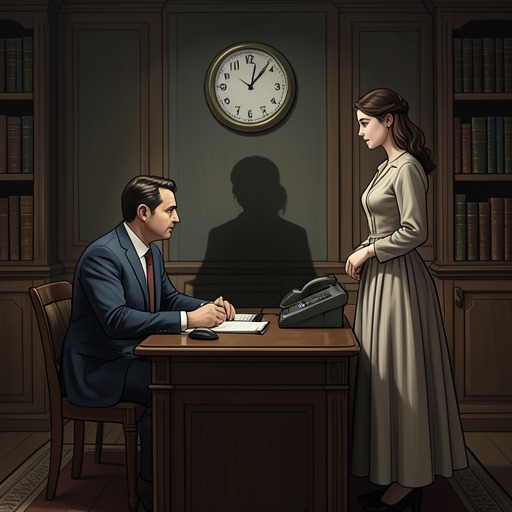
The details inside the rooms make that concealed life tangible. On one visit, Spade finds the blue gown Brigid wore the previous night hanging across the foot of the bed, with her blue stockings and slippers on the bedroom floor. A polychrome box that had held jewelry in the dressing-table drawer is now empty and placed on top of the dressing table. He frowns, looks through the rooms without touching anything, and leaves. The garments and emptied box are not explanations by themselves, but they register a changed, depleted apartment and sharpen his attention to what Brigid has moved or hidden.
A changing address in the investigation
The apartment also acts as a practical point of reference as Spade follows a case whose participants keep changing positions. He enters with a key Brigid had given him, making his access possible through their relationship even as his work requires him to treat her story with suspicion. On a later visit, he finds nobody there and observes that nothing has changed since his previous visit. The contrast between the earlier empty jewelry box and this unchanged interior emphasizes how little an apparently static room can settle: the apartment can hold clues while its occupant remains absent.
That absence becomes dangerous when Gutman’s party locates Brigid there. Gutman later recounts that he and Joel Cairo searched through the day and finally found the apartment. Listening at the door, they heard people moving inside. After they rang and identified themselves, they heard a window being raised. The sound made the occupants’ attempted escape clear to them, and Wilmer Cook hurried downstairs to cover the fire escape. The apartment’s exits thus turn a meeting at the door into a coordinated pursuit around the building.
The struggle at the windows and alley
In Gutman’s account, Wilmer meets Jacobi in the alley behind the building as the captain runs away with the falcon under his arm. Wilmer shoots him more than once, but Jacobi remains on his feet and keeps hold of the bird. At close quarters, Jacobi knocks Wilmer down and escapes. A policeman is approaching from the block below; Wilmer gives up the chase, slips through an open back door in the neighboring building, and returns to Gutman’s party without being seen.
The sequence makes the apartment a hinge between a threatened escape and the falcon’s onward journey. Gutman says that Brigid shut the window behind Jacobi and then opened the door to him and Cairo. She told them that she had sent Jacobi to take the bird to Spade. Gutman’s group then persuaded her to telephone Spade’s office in an effort to draw him away before Jacobi arrived, while sending Wilmer after the captain. Their plan depended on Brigid’s access to Spade and on their ability to control the information coming out of the apartment; the delayed decision left Jacobi able to get away with the bird.
Gutman’s story also connects the Coronet to an earlier attempt to force Brigid back into an alliance. He says he knew she was Thursby’s ally and that killing Thursby in that manner was intended to leave her without her violent protector and encourage her to make peace with Gutman’s party. He denies that the group thought Thursby possessed the falcon. They knew Brigid had given it to Jacobi in Hongkong to bring to San Francisco aboard the Paloma while she and Thursby traveled on a faster boat. The apartment therefore stands at the end of a chain of divided knowledge: Brigid’s hidden arrangement, Gutman’s partial understanding, and the violent pursuit of Jacobi converge there.
Evidence, confession, and significance
When Spade returns to the apartment and finds its contents unchanged, he does not treat that as proof that nothing has happened. Earlier, he has read the empty jewelry box and the clothing left in the bedroom as signs worth noting; later, he uses the rent receipt and the trunks as concrete grounds for challenging Brigid’s story about when she rented the place. The apartment’s material details work against her account because they have dates, locations, and physical consequences that her words cannot erase.
Brigid eventually admits that she lied about her intention concerning Thursby and Archer. Spade reconstructs the plan from the apartment’s prior rental, the trunks stored there, and her attempt to arrange for a known shadower. He argues that she wanted someone familiar to follow Thursby so that Thursby might attack him, allowing her to be rid of one man or, if Archer died, to have Thursby caught and be rid of him instead. The Coronet is thus evidence not only of flight after the murders but of preparation before them.
Across these episodes, the apartment changes meaning without changing its physical address. It is first presented through Brigid’s guarded account of dependence and betrayal, then inspected as a room containing signs of absence and removal, and finally exposed as a prepared base tied to the murder plot and the falcon’s escape. Its doors, window, fire escape, bedroom, and dressing table make private space inseparable from surveillance and pursuit. The Coronet matters because the investigation can read what Brigid leaves behind there even when she refuses to say what the place was meant to conceal.